AI Search Optimisation Agency for Overseas Businesses
How overseas businesses can vet an India-based AI search optimisation agency for AEO, GEO, technical SEO and conversion-focused web design.
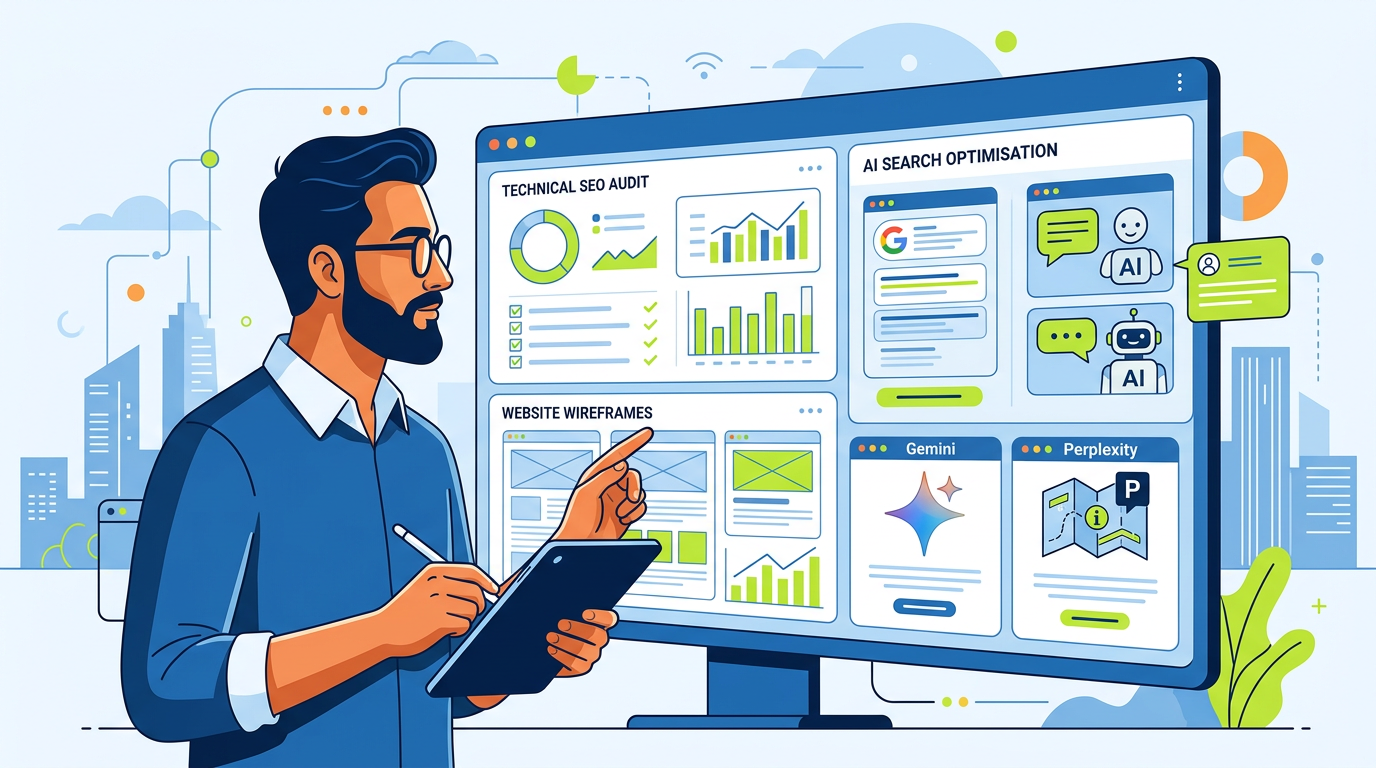
An AI search optimisation agency for overseas businesses should prove it can improve discoverability in Google AI Overviews, ChatGPT, Gemini and Perplexity while fixing the technical and conversion gaps on your website. When hiring in India, vet deliverables, ownership, reporting, timezone process and real design capability before comparing rates.
What should overseas businesses check before hiring an AI search optimisation agency in India?
I would start with one question: can this agency connect AI-search visibility to commercial outcomes?
AEO (Answer Engine Optimisation) and GEO (Generative Engine Optimisation) are not standalone tricks. A business can earn a citation in an AI answer and still lose the lead if its landing page is slow, vague, inaccessible, poorly structured or designed without a clear next step.
For US, UK, Australian and Gulf businesses, I recommend checking six areas before signing anything:
- Evidence of technical SEO competence
- A practical AEO/GEO content methodology
- Conversion-focused website design capability
- Clear communication and review overlap
- Full ownership of domains, analytics and source files
- Reporting that does not pretend AI-search visibility is perfectly measurable
An India-based studio can be an excellent fit when the work is led by someone who understands both website delivery and search strategy. It is a poor fit when the offer is simply “100 AI articles per month” or a cheap backlink package.
AI-search visibility is useful only when your owned website gives the visitor a clear reason to trust and contact you.
I work from Delhi with clients across India and overseas markets, but I do not recommend choosing an agency purely because it is located in India. The lower cost can be valuable. The real advantage is getting strategy, design, development and SEO execution from one accountable team.
Before a discovery call, review the agency’s portfolio, ask for examples relevant to your site type, and check whether the live sites still work well on mobile. A polished Behance screen is not proof of technical delivery.
For example, on a recent NGO build for Sarv Dharam Sewa Sangh, the requirement was not simply an attractive website. The site needed clear programme pages, trust signals, donation-oriented user journeys and a structure that volunteers and supporters could understand quickly. That same thinking applies to a B2B consultancy, SaaS company, clinic or e-commerce business selling overseas.
AEO, GEO and technical SEO: ask for deliverables, not AI-search promises
No credible agency can guarantee that ChatGPT, Gemini, Perplexity or Google AI Overviews will cite your business for a specific prompt. These systems change sources, vary by location and query, and do not provide a stable equivalent of a Google keyword ranking report.
What an agency can promise is a defined body of work that makes your website easier to crawl, understand, quote and trust.
The deliverables I would expect in the first 30 days
A serious AEO/GEO and technical SEO engagement should normally include:
- A crawl and indexation audit using Screaming Frog SEO Spider 22+ or Sitebulb
- Google Search Console review, including indexing, sitemap, page experience and query patterns
- GA4 access and conversion-event review
- Core Web Vitals assessment using PageSpeed Insights, Chrome DevTools and CrUX data where available
- Information architecture review
- Schema review using Schema Markup Validator and Google Rich Results Test
- Competitor and AI-answer source analysis
- Priority keyword and question map by commercial intent
- Content brief templates built around direct answers, evidence, entities and supporting sections
- A technical implementation backlog ranked by impact and effort
- A citation-monitoring baseline for a defined set of target prompts
If the agency says “we optimise for ChatGPT” but cannot explain its crawl, schema, entity, internal-linking and source-quality process, I would not hire it.
The useful work is usually less glamorous than the pitch. It includes repairing duplicate title tags, resolving indexation conflicts, improving page copy, adding author and organisation details, clarifying services, building internal links, reducing template bloat and strengthening proof on key pages.
For a deeper explanation of the methodology, see my guide on AEO & GEO in 2026: how to get cited by ChatGPT, Gemini and Perplexity. This article is about vetting a partner, not repeating the full implementation playbook.
What I would not recommend
I would not recommend:
- Guaranteed AI Overview placement
- Guaranteed ChatGPT citations
- Bulk AI pages with minimal human editing
- “GEO packages” built entirely around publishing 50 generic articles
- Schema added blindly to every page
- Mass guest-post links from irrelevant sites
- Monthly reports showing only keyword positions and backlink counts
Google’s systems and AI answer engines reward useful, original, clearly sourced information. Publishing more pages than your business can genuinely support is not a durable strategy.
The best AI-search content answers a specific question quickly, then proves why the answer deserves trust.
Can the agency build a site that converts after it earns an AI citation?
This is the question many overseas buyers miss.
AI search can send a visitor to your site, but the website must do the next job: explain the offer, establish relevance, reduce perceived risk and make conversion simple. If you hire one provider for AEO/GEO and another for design, accountability becomes fragmented very quickly.
A good agency should be able to assess:
- Above-the-fold message clarity
- Primary call-to-action placement
- Form length and friction
- Mobile navigation
- Page speed and image handling
- Service-page structure
- Pricing or qualification transparency
- Testimonials, case studies, credentials and proof
- Location and market relevance
- Accessibility basics, including contrast, labels and keyboard interaction
On the Luft Holidays travel project, the website had to do more than list packages. A travel enquiry is a high-consideration action. The page structure needs destination context, itinerary confidence, visual appeal, enquiry clarity and enough trust detail for a visitor to take the first step.
Likewise, Buddha Beauty Point required a different conversion journey: service discovery, visual reassurance, booking intent and local credibility. Different industries need different page logic. A generic “SEO landing page template” is rarely enough.
Ask to see the wireframe, not only the finished homepage
When you evaluate a studio, ask how it moves from research to layout. I would expect to see:
- Audience and offer assumptions
- A page hierarchy or wireframe
- Copy direction before visual polish
- Mobile-first review
- Development staging link
- QA checklist before launch
- Event tracking for form submissions, calls, bookings or checkout actions
A website redesign should not be treated as separate from search strategy. The headings, copy blocks, FAQs, internal links, evidence and conversion elements all affect how users and systems interpret the page.
You can review my wider services to see how website design, technical SEO and AI-search optimisation fit together.
Compare scope, ownership and cost before comparing hourly rates
Hourly rate is one of the least useful ways to compare an overseas agency.
A $12-per-hour freelancer with no documented process can cost more than a $35-per-hour specialist if you spend weeks correcting communication, quality and ownership problems. Equally, a high-priced agency is not automatically better if it assigns your account to a junior team after the sales call.
Use scope and outcome accountability first, then use cost as one variable.
| Engagement type | Typical India-based range | Approximate INR range | What should be included | Common risk |
|---|---|---|---|---|
| Technical SEO audit | $500–$1,500 | ₹42,000–₹1,25,000 | Crawl audit, prioritised fixes, GSC/GA4 review, Core Web Vitals review | Audit PDF with no implementation support |
| AEO/GEO foundation, 60–90 days | $1,200–$4,000 | ₹1,00,000–₹3,35,000 | Research, page improvements, schema, content briefs, tracking baseline | Empty promises of AI citations |
| Monthly SEO and AI-search support | $800–$3,000/month | ₹67,000–₹2,50,000/month | Technical monitoring, content work, reporting, implementation support | Volume-led content with no business focus |
| Conversion-focused business website | $2,500–$8,000 | ₹2,10,000–₹6,70,000 | Strategy, UX, design, development, responsive QA, launch support | Template site dressed up as custom work |
| Larger custom platform or e-commerce build | $8,000–$25,000+ | ₹6,70,000–₹21,00,000+ | Discovery, custom workflows, integrations, testing, documentation | Under-scoped build and future maintenance surprises |
These are working ranges, not fixed market prices. Exchange rates, platform choice, content volume, integration complexity and stakeholder approvals can change the final figure. Verify any proposal by asking for a page-level or sprint-level scope.
For a fuller comparison of what budgets buy across markets, read What a conversion-focused website costs in the US vs India.
Questions I would ask before approving a proposal
- Who will personally lead strategy and client communication?
- Which tasks are included every month, and which are out of scope?
- How many pages, templates or content assets are included?
- Does implementation sit with the agency or my in-house developer?
- Are copywriting, research and design included?
- What platform will the site use: WordPress, Webflow, Shopify, custom stack or something else?
- What is the review and approval process?
- What happens if launch timing slips because we delay feedback?
- Is there a minimum contract term?
- What access and files will I receive at the end?
A clear scope protects the client and the agency because it turns vague expectations into deliverable decisions.
How much communication overlap do US, UK, Australian and Gulf teams need?
You do not need eight hours of live overlap to run a good website or SEO engagement. You do need predictable windows for decisions, reviews and urgent issues.
India operates on IST, UTC+5:30. That makes it naturally convenient for Gulf and UK teams, workable for Australia, and manageable for US clients with planned overlap.
| Client market | Typical time difference from IST | Practical overlap approach |
|---|---|---|
| UAE / Gulf | IST is 1.5 hours ahead of UAE | Near-full business-day overlap |
| UK | IST is 4.5–5.5 hours ahead depending on BST/GMT | UK morning and India afternoon work well |
| US East Coast | IST is 9.5–10.5 hours ahead depending on daylight saving | US morning / India evening for 1–3 hours |
| US West Coast | IST is 12.5–13.5 hours ahead | Schedule 2–3 fixed weekly windows; rely on async updates |
| Australia East Coast | Australia is usually 4.5–5.5 hours ahead of IST | India morning / Australia afternoon works well |
For overseas clients, I recommend a simple operating rhythm:
- One kickoff call
- One weekly 30–45 minute decision call during active build work
- Async updates in email, Slack, ClickUp, Notion or Basecamp
- A shared approval system for copy, design and development
- Screen-recorded walkthroughs using Loom
- Written weekly priorities, blockers and next actions
I use async communication heavily because it prevents the “what did we decide?” problem. A Loom video attached to a staging link is often more useful than a long meeting, especially when a client has multiple stakeholders in London, Dubai and New York.
Do not hire an agency that insists every decision must happen over live calls. That model breaks down across time zones.
For a more detailed process, read working with an offshore web partner across time zones.
Who owns the domain, analytics, content, code and AI-search work?
The answer should be simple: you own your business assets.
I have seen overseas businesses get locked out of domains, Google Analytics, Google Search Console, advertising accounts, hosting panels or source repositories because an agency created everything under its own email address. That is avoidable.
Your agreement should state that the client owns the following from day one:
- Domain registrar account
- Hosting account or billing relationship
- Google Search Console property
- GA4 property
- Google Tag Manager container
- Google Business Profile where relevant
- CMS administrator account
- Design files in Figma, where applicable
- Website source code or repository access
- Copy, research documents and content briefs
- Image licences and paid plugin licences
- Schema implementation and technical documentation
- CRM, form and payment integration accounts
- AI-search prompt tracking sheets and reporting data
Agency access should be delegated, not proprietary
Your agency can have administrator or editor access. It should not be the only entity able to access the account.
For WordPress, I prefer client-owned hosting and a client-controlled administrator account, with the studio given appropriate access. For Webflow, Shopify, HubSpot and similar platforms, the client should own the workspace or primary organisation account.
A practical handover should include:
- Login and account inventory
- Plugin list and licence renewal dates
- Backup location
- DNS record summary
- Redirect list
- Analytics and conversion-event documentation
- Content publishing process
- Open technical issues
- Repository or zip archive where relevant
If an agency controls every login, it controls your ability to change agencies.
What does credible reporting for AI search optimisation actually look like?
AI-search reporting is evolving, so honest reporting matters more than impressive dashboards.
Google Search Console does not give a neat line item called “AI Overview clicks” for every market and query. ChatGPT, Gemini and Perplexity do not offer universal, reliable referral and citation reporting for all businesses either. Anyone showing exact monthly “AI ranking positions” without explaining methodology deserves scrutiny.
A credible report should combine direct data with transparent observation.
What I would include in a monthly report
Technical health
- Index coverage changes
- Crawl errors
- Broken links and redirect issues
- Core Web Vitals trends
- Sitemap, canonical and structured-data issues
Organic search performance
- Clicks, impressions, CTR and query trends from Google Search Console
- Landing-page performance
- Branded versus non-branded growth
- Leads, sales, bookings or qualified enquiries from GA4
Implemented work
- Pages improved
- Schema added or corrected
- Internal links created
- Content briefs written or published
- UX and conversion improvements completed
AI-search observation
- A fixed prompt set
- Country, language and date checked
- Whether the brand, site or cited sources appeared
- Screenshots or archived notes where feasible
- Changes in cited competitor and source patterns
Next-month priorities
- What will be fixed next
- Why it matters
- Dependencies on client approvals or developers
The phrase “fixed prompt set” matters. If a report checks different prompts each month, the comparison is weak. Use 20–50 relevant prompts at the start, grouped by service, product, location and buyer question. Check them consistently, while acknowledging that AI answers can change between sessions and locations.
I would also connect reporting to measurable business actions. A lead form completion, booked call, quote request, demo request or sale matters more than an unverified claim that a page “ranked in AI.”
For context on measuring performance when answers reduce clicks, see Zero-Click Is the New Baseline.
Use a 48-hour mockup to reduce risk before committing to a full engagement
A low-risk 48-hour mockup is one of the fastest ways to evaluate whether an agency understands your business.
It is not a full website. It is not a free production build. It is a focused strategic concept that shows the quality of thinking before a larger commitment.
For suitable projects, I can create a free 48-hour website mockup around one priority page, usually a homepage or high-value service page. The purpose is to show how I would position the offer, structure the content, guide the user and support search clarity.
What a useful 48-hour mockup should include
- A quick review of your current website and competitors
- Primary audience and offer assumptions
- A proposed hero section and conversion path
- A clear page hierarchy
- Sample content direction and headings
- Recommended calls to action
- Initial trust and proof placement
- Mobile-aware layout thinking
- A short explanation of SEO/AEO implications
- Assumptions and items needing validation
It should not include a complete 20-page website, a fully coded application, unrestricted revisions or a promise that the concept is ready to launch without discovery.
The right way to use the mockup is as a working test. Ask yourself:
- Does the agency understand our actual buyer?
- Is the message specific to our market?
- Does the layout make the next action obvious?
- Are there signs of real technical and search knowledge?
- Can the person explain trade-offs clearly?
- Would I trust this team with our brand assets?
Overseas agency vetting checklist
- Review three live websites, not only design screenshots.
- Test those websites on mobile and check page load behaviour.
- Ask for the named person leading strategy, design and technical SEO.
- Request a deliverables-based proposal with dates and exclusions.
- Confirm whether AEO/GEO work includes technical SEO and conversion improvements.
- Reject guaranteed AI citation or AI Overview promises.
- Ensure your company owns domain, hosting, GA4, GSC, GTM and CMS access.
- Set a fixed weekly communication window before work begins.
- Ask for a sample report and challenge the AI-search measurement methodology.
- Use a 48-hour mockup or a paid discovery sprint before a large build.
- Document approval turnaround times and who has final sign-off.
- Confirm the post-launch support period, handover process and ongoing maintenance terms.
The bottom line
An India-based AI search optimisation agency can give overseas businesses strong value, but only if it combines AEO/GEO with technical SEO, conversion design, clear ownership and disciplined communication.
Do not buy an “AI ranking” promise. Buy a defined process: better site structure, stronger evidence, useful content, faster pages, measurable conversion paths and transparent reporting.
If you want to test the fit before committing, request a free 48-hour website mockup or book a call through my contact page. You can also review my pricing and portfolio before getting in touch.
FAQ
What is an AI search optimisation agency, and how is it different from a conventional SEO agency?
An AI search optimisation agency works on visibility in answer-led search experiences such as Google AI Overviews, ChatGPT, Gemini and Perplexity, alongside conventional organic search. The practical work overlaps with good SEO: technical health, clear page structure, useful content, entities, schema, authority and credible evidence. The difference is that the agency should also consider how answer engines extract, summarise and cite information.
Can an India-based agency realistically support US, UK and Australian working hours?
Yes, if the agency uses planned overlap and strong async communication. UK and Gulf clients have convenient overlap with India, Australia is usually manageable during India mornings, and US clients benefit from fixed early-morning or evening India call windows. You do not need daily meetings; you need reliable decision points, written updates and quick escalation for blockers.
What should I own when I hire an offshore AEO or GEO agency?
You should own the domain, hosting, Google Search Console, GA4, Google Tag Manager, CMS, source files, design files, content, research, tracking documents and paid software accounts. Give the agency delegated access rather than allowing it to create critical business assets under a private account. Your contract should also include handover requirements and a complete access inventory.
How can I verify whether an agency’s AI-search reporting is credible?
Ask to see a sample report and look for transparent methodology. It should identify the exact prompts tracked, country or market checked, dates, screenshots or notes, technical work completed and business results from analytics. Be cautious if it claims exact AI rankings or guaranteed citations without acknowledging that generative answers vary by query, user, location and time.
What should be included in a 48-hour website mockup?
A useful mockup should show one priority page concept, a proposed message hierarchy, conversion path, initial calls to action, trust placement and sample content direction. It should also explain the assumptions behind the design and highlight SEO or AEO opportunities. It is a fit-assessment tool, not a free replacement for full discovery, copywriting, development and QA.
How much should an overseas business budget for AEO, technical SEO and conversion-focused web work in India?
A technical audit commonly ranges from $500 to $1,500, while a 60–90 day AEO/GEO foundation can range from $1,200 to $4,000 depending on site size and implementation needs. Monthly support often falls between $800 and $3,000, and a conversion-focused business website can range from roughly $2,500 to $8,000. Verify the quote against page count, research depth, content, design, development, integrations and post-launch support rather than using price alone.
Work with me
Want the same for your business?
I help founders in India and worldwide ship fast, SEO-ready websites that rank on Google — and get cited by AI search.
Start a projectKeep reading

Nobody Is Clicking Your Website Anymore — Here's How to Get ChatGPT to Recommend You Instead
AEO & GEO in 2026: How to Get Cited by ChatGPT, Gemini and Perplexity

AEO & GEO Explained: How to Rank in ChatGPT, Perplexity & Google AI Overviews
SEO Services in India: What Actually Works in 2026 (Post-AI-Search)

Is SEO Dead in 2026? The Shift to AI Search and Citations