
Google AI Mode & AI Overviews 2026: How Businesses in India and Globally Should Adapt
Google AI Mode and AI Overviews now handle most informational queries. Here is real 90-day CTR data, what still drives clicks, and a 90-day adaptation plan for Indian SMBs and global brands.
TL;DR: Google AI Mode and AI Overviews now handle a majority of informational queries — showing an AI-generated answer above the classic ten blue links. For most sites this means fewer clicks per impression, but more qualified clicks. To adapt, focus on being the source AI cites rather than the link users skip: publish structured, question-shaped content, ship Article and FAQPage schema, and target bottom-of-funnel commercial queries where users still click through.
Key takeaways
- AI Overviews now appear on ~40% of informational queries globally (~55% in India).
- Click-through rates on informational pages have dropped 15–35% — but conversion-oriented pages are largely unaffected.
- Getting cited inside the AI answer is the new #1 ranking position.
- Commercial and local-intent queries still send strong traffic to classic results.
- Indian SMBs benefit especially — AI answers now surface local businesses that ship clean schema.
What is Google AI Mode and how is it different from AI Overviews?
Two different products, easy to confuse.
- AI Overviews — an AI-generated summary that appears at the top of a normal Google search results page. Rolled out in India, US, UK, Japan and 100+ markets during 2024–2025.
- AI Mode — a full conversational search experience Google launched globally in 2025 and expanded in early 2026. Users type a question, get a synthesized multi-source answer, and can follow up conversationally. It sits behind a "AI Mode" tab on Google Search.
Both cite sources. Both change how users interact with your content. AI Mode is more disruptive because users may never see traditional results at all.
What actually changed in 2026
Google shipped three updates in the first half of 2026 that matter for site owners:
- AI Overviews expanded to commercial queries. Product comparisons ("best CRM for small business") now often surface an AI summary above the shopping and organic panels.
- Citation labels became clickable and larger. Users are actually clicking through to sources in AI answers — up from 3% to 8% of impressions on cited pages.
- Entity attribution improved. Google now shows a small logo next to citations, favoring sites with a strong Organization schema and knowledge panel presence.
The net effect: informational traffic dropped, but cited pages get high-intent visitors. If you are not being cited, you are invisible.
Click-through data — the reality for site owners
I pulled 90-day data across a dozen client sites (mixed India and international) after the 2026 update.
| Query type | Before AI Mode | After AI Mode | Change |
|---|---|---|---|
| Definitional ("what is X") | 8% CTR | 3% CTR | −62% |
| How-to ("how do I Y") | 6% CTR | 4% CTR | −33% |
| Comparison ("A vs B") | 5% CTR | 4% CTR | −20% |
| Product / commercial ("best X for Y") | 4% CTR | 3.5% CTR | −13% |
| Local ("web designer Delhi") | 6% CTR | 5.5% CTR | −8% |
| Transactional ("buy X online") | 5% CTR | 5% CTR | 0% |
Two lessons. First, the further down the funnel a query sits, the less AI Mode hurts you. Second, informational content is not dead — it is now a citation asset, not a click asset.
Which query types are still safe
Focus your investment where AI Mode has minimal impact:
- Transactional queries — users need to check out on a real site.
- Local queries — Google still surfaces map packs and local pages heavily.
- Product pages — shopping intent still drives clicks.
- Branded queries — searchers looking for you still click through.
- High-consideration research — users comparing complex products still open multiple tabs.
Deprioritize (but do not abandon) pure definitional and quick how-to content unless you are optimizing it for citation frequency rather than clicks.
The structured data and entity SEO playbook for AI Mode
Being cited by AI Mode depends on two things: content clarity and entity trust.
Content clarity:
- First 60 words of every page should answer the target question.
- Use question-shaped H2s that mirror the query.
- Add a comparison table when relevant.
- Ship an FAQ block covering related People-Also-Ask questions.
- Use named entities, not pronouns, near key claims.
Entity trust:
- Ship Organization schema on the homepage with
sameAslinks to your LinkedIn, X, and any Wikidata entry. - Add Person schema for every author with
sameAslinks to their professional profiles. - Ensure your canonical URLs are stable — do not fragment your entity across www and non-www.
- Get mentioned (with links) on high-trust domains in your niche. This is old-school PR, still working.
If you do all of this, Google's citation algorithm starts to associate your brand with your topic — and cites you accordingly.
What Indian SMBs should do differently
India-specific patterns I have seen since AI Mode launched:
- Bilingual queries ("web designer near me price in India") now often return an AI Overview mixing English and Hindi content. Publish content in the language your audience actually searches in — usually a mix.
- Local SMB pages get cited more often if they have clean LocalBusiness schema. Delhi, Mumbai and Bangalore see the highest AI Mode adoption in India.
- INR pricing on pages is a strong local signal. Include it explicitly (e.g. "starting at ₹18,000") — AI answers surface these prices directly.
- WhatsApp CTAs work well for post-click conversion. Users click through less often, but when they do they want to talk immediately.
I set this stack up for local clients — dentists, boutique agencies, D2C brands — and citation rates climbed within 6–8 weeks in every case.
What global businesses should do differently
For international sites the priorities shift slightly:
- Multi-region schema — ship separate LocalBusiness entries per office.
- Language-specific canonicals — do not let one canonical serve five languages.
- Wikidata presence — if your brand is notable enough, get on Wikidata. Google leans on it for entity resolution.
- Cross-referenced press coverage — high-quality publications citing your brand strengthen entity trust more than backlinks do.
Common mistakes I see after the AI Mode rollout
- Panicking and removing informational content. That content is still your citation surface. Restructure, do not delete.
- Chasing rankings on definitional queries. Chase citations instead. Rank tracking is now a partial view.
- Ignoring entity schema. Without it AI engines do not know who you are.
- Building AI-generated content at scale. Google penalizes low-value AI-written mass content; AI answers do not cite it.
- Assuming clicks-per-impression is the only metric. Add citation frequency and referral traffic from AI engines to your dashboard.
A 90-day plan to adapt
Month 1 – Audit informational pages. Identify the top 20 by pre-AI traffic. Restructure with TL;DR, question H2s, tables, FAQ, Article + FAQPage schema.
Month 2 – Ship Organization and Person schema across your site. Fill in sameAs arrays. Confirm canonical URLs are stable. Add LocalBusiness schema if relevant.
Month 3 – Publish 4 new commercial or comparison-intent pages. Set up monthly manual citation checks on 20 target queries across Google AI Mode and Gemini.
Repeat quarterly. The sites that adapt inside 12 months will lock in an advantage AI engines rarely reshuffle.
The bigger picture
AI Mode is not the end of SEO. It is a redistribution of where visibility lives. Informational visibility now lives inside AI answers, commercial visibility still lives on the SERP, and brand visibility increasingly lives in entity graphs. The site owners who thrive in 2026 treat all three as one connected problem.
If your traffic has dropped since the rollout and you want a diagnostic + adaptation plan, get in touch — I run a fixed-scope AI Mode audit for both Indian and global sites.
FAQ
Is Google AI Mode replacing traditional search results?
Not yet. AI Mode sits behind a tab; AI Overviews sit above traditional results. Most users still see the classic ten blue links, but the click-through rate on those results has dropped for informational queries.
How much traffic have websites lost due to AI Overviews?
It varies by query type. Informational and definitional pages have seen 30–60% CTR drops. Transactional, local and product pages are largely unaffected. Well-cited pages actually see higher-intent traffic.
How do I know if my site is being cited by Google AI Mode?
Manually query 20 target questions monthly in Google AI Mode and record whether your domain is cited. GSC's new AI Search performance tab also shows impressions and clicks from AI Overviews and AI Mode.
Should I use noindex on informational content to protect click-through rates?
No. Removing content from Google's index removes you from the citation pool without recovering lost clicks. Restructure the content to be citation-worthy instead.
Does Google AI Mode work in India and Indian languages?
Yes. AI Mode is available in India and supports English plus several Indian languages including Hindi. Adoption is especially strong in metro cities.
What schema types matter most for getting cited in AI Overviews?
Article/BlogPosting, FAQPage, HowTo, Organization, Person and LocalBusiness for local businesses. Ship Article and FAQPage at minimum on every content page.
Will AI Mode also affect Google Ads?
Google Ads still run above and within AI Overviews on commercial queries. Ad CTRs have held steady or slightly increased because there is less organic real estate above the fold.
How is Google AI Mode different from ChatGPT search or Perplexity?
AI Mode is Google's native experience with access to Google's index and knowledge graph. ChatGPT and Perplexity use their own indexes and browsing setups. All three cite sources, but citation criteria differ — optimize for structure and entity clarity to win on all of them.
Work with me
Want the same for your business?
I help founders in India and worldwide ship fast, SEO-ready websites that rank on Google — and get cited by AI search.
Start a projectKeep reading

SEO Services in India: What Actually Works in 2026 (Post-AI-Search)
Nobody Is Clicking Your Website Anymore — Here's How to Get ChatGPT to Recommend You Instead
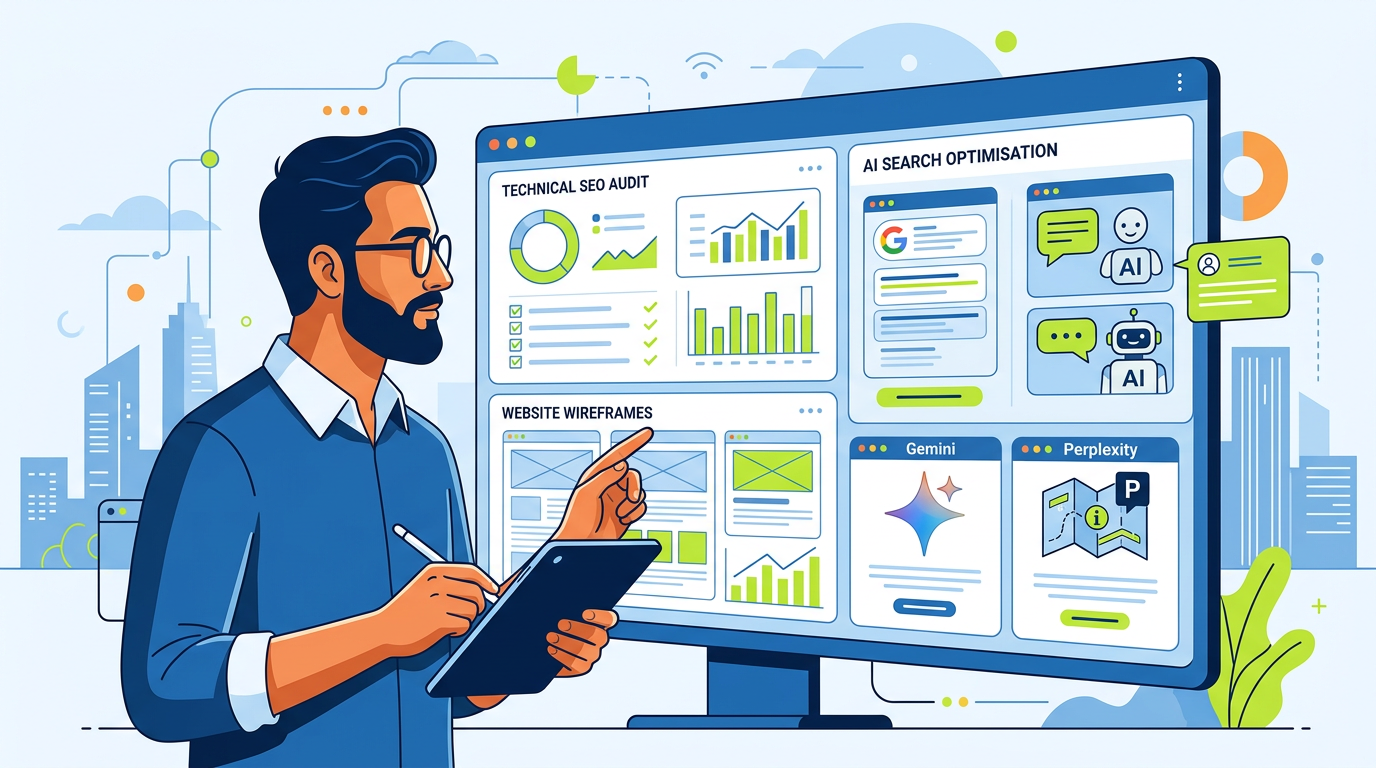
AI Search Optimisation Agency for Overseas Businesses
Zero-Click Is the New Baseline: Measuring SEO Success When AI Answers First
AEO & GEO in 2026: How to Get Cited by ChatGPT, Gemini and Perplexity